A Secret to Breaking Through Genealogy Brick Walls
Oct 08, 2026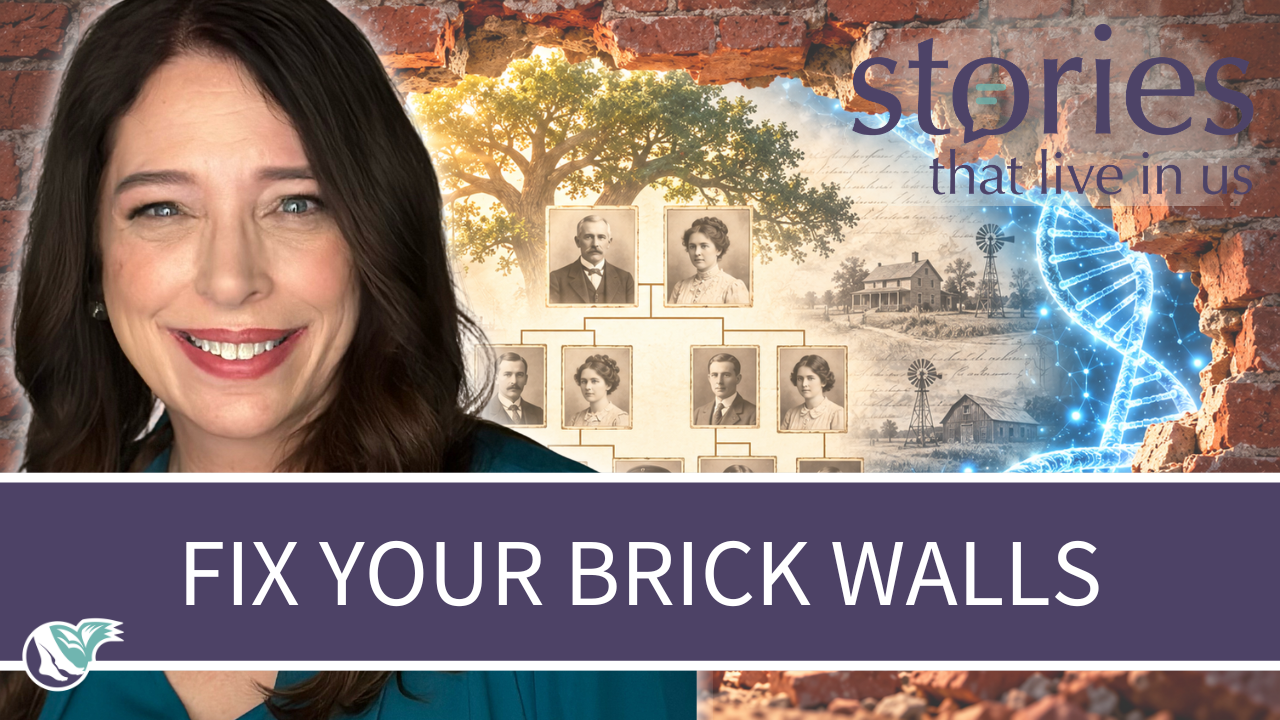
Have you ever hit a wall in your family tree research, stared at your DNA match list for hours, and felt like you were completely out of ideas?
I’ve been doing family history for decades, and I’m going to share a secret that might sound a little counter-intuitive at first. The fastest way to break through your own genealogy brick walls is:
STOP RESEARCHING YOUR OWN FAMILY TREE
When you're stuck on your own pedigree, emotional attachment and confirmation bias can get in the way. You want a line to connect so badly that you end up looking right past the obvious answer. But when you step away from your personal pedigree and take on a completely unfamiliar family tree, everything changes. You learn to drop your assumptions, show your work step-by-step, and build research muscles that turn you into a sharper genealogist.
In our latest podcast episode, my long-time friend, colleague, and producer Lisa Elzey sat down with me to look back at two massive research projects that shaped our approach to genetic genealogy and our own brick walls: untangling the dark history of the 1950s Georgia "Hicks babies" adoptions and researching the immigrant roots of the Broadway cast of Anastasia.
Listen in to learn what working on other people's trees taught us and how you can use those exact same strategies to solve your own family history brick walls.
The Whole Story
Watch the full conversation with Lisa Elzey or jump straight to key moments in the episode:
Prefer audio only? Click here to listen on your favorite podcast app.
- 01:40 - DNA 101 & The Hicks Babies Adoption Ring Case
- 06:10 - Untangling Endogamous Families in Rural Georgia
- 12:45 - Overcoming Bias & Learning to "Show Your Work"
- 19:40 - From Georgia Mountains to Broadway: The Anastasia Project
- 27:40 - Connecting Immigrant Stories on the Streets of New York
- 37:30 - One Word, One Story: Crayons Memory
4 Lessons Learned from Researching Other People's Family Trees
1. You Drop Your Confirmation Bias
When you research your own ancestors, you carry subconscious expectations about how a story should look. When Lisa was researching a mystery in her own DNA, she found herself looking right past a straightforward match because her mind expected the line to be far more complicated.
"When you're looking for an answer to something in your own DNA and it just isn't measuring up, sometimes you're not looking straight at the thing—you're looking past it. You think, 'It can't be a straight line, it has to be way over here to be the answer.'"
Working on a stranger’s tree removes that personal bias entirely. You evaluate the evidence cold, looking purely at what the records and DNA numbers tell you.
2. You Learn to "Show Your Work"
Back in 2013 and 2014, when AncestryDNA was brand new and had fewer than two million people in the database, we took on a high-stakes case involving the "Hicks babies." Dr. Thomas J. Hicks ran a clinic in rural Fannin County, Georgia, in the 1940s and 50s, telling mothers their newborns had died while selling the babies out the back door in an illegal adoption ring.
Solving those cases required rigorous precision. We had to chart shared centimorgans, build complex trees, and map out every generation using whiteboards and colored pens. (It’s gotten a little more high-tech since then but we do love the a good whiteboard session even now.) As Lisa always reminds herself: "Do the math, do the tree work, do the math again." When you learn the mechanics of proving relationships manually, automated research tools become much easier to verify.
3. You Become a Regional Specialist
When we were untangling the families of Fannin County in the Blue Ridge Mountains, we ran into heavy endogamy in this isolated mountain community where families intermarried across generations. To figure out who belonged to whom, we had to build out entire regional family trees rather than just isolated branch lines.
By familiarizing ourselves with the recurring surnames of the region, we learned to spot which matches were direct biological connections and which were double cousins or married-in lines. Working outside your own pedigree forces you to become familiar with local history, state and county boundary lines, and migration corridors. Taking that skill back into your own family tree can only help you.
4. You Reconnect with Pure Storytelling
In 2017, Lisa took on a project researching the family trees and DNA of the Broadway cast and creative team of Anastasia. From actor Derek Klena's Slovakian roots to performer Mary Beth Peil tracing her family back to Württemberg, Germany, Lisa discovered that almost all of these performers had ancestors who had originally passed through the ports of New York.
Telling those stories to Broadway performers (and seeing producer Tom Kirdahy break into tears looking at his grandfather's Syrian naturalization paper) reminded us that genealogy isn't just about names and dates on a chart. It’s about human connection.
🎭 Watch the Discoveries: Want to see the cast's real-time reactions? You can watch Lisa’s video series with the Broadway cast of Anastasia on YouTube to see their family history discoveries unfold!
Behind the Record: 3 Advanced Research Techniques
If you want to sharpen your genealogy skills, try applying these three methodologies to your next brick wall:
- Follow the FAN Club: If your ancestors lived in an isolated rural county or an endogamous community, stop looking at them in isolation. Build trees for neighboring families and recurring surnames in that township. Understanding the broader community network often reveals hidden parental lines.
- Use Target DNA Testing: When your AncestryDNA Match List leaves you stuck between two brothers or cousins as candidate ancestors, identify living descendants of specific branches and request target DNA tests. A single strategically placed test can solve decades of uncertainty.
- Trace Migration Hubs & Naturalizations: When researching immigrant ancestors, focus heavily on port-of-entry records, passenger manifests, and naturalization documents in hub cities like New York. Many of those documents frequently contain the exact village or origin parish overseas.
Story Seeds 🌱
Use one (or all!) of these conversation starters at your next Sunday dinner or family gathering and watch connection grow across generations.
- Have you ever felt a deep, unexplainable connection to a specific town, region, or historic place you’ve visited?
- If you could sit down and talk with one ancestor who immigrated to a new country, who would it be and what would you ask them?
- What simple object or smell from your childhood—like a fresh box of crayons or a favorite meal—instantly brings back a vivid memory?
Story Sparks 🔑
Ready to dig deeper into your own family history this week? Here are four practical steps to turn facts into connections.
- Build a "Practice Tree": Pick a historical figure, a neighbor, or a friend who needs help, and build out three generations of their family tree. Pay attention to how your decision-making changes when you have no emotional bias toward the outcome.
- Show Your Math: Take your most confusing DNA match and write down the exact centimorgan (cM) count. Map out every possible relationship tier supported by that cM count before reaching a conclusion.
- Color-Code Your Match Groups: Use custom grouping tools or simple color tags to organize your DNA matches by shared ancestral lines rather than looking at them as one long, overwhelming list.
- Document the Port of Entry: Find the original passenger manifest or naturalization paper for your first ancestor who arrived in a new country. Look closely at each column (don’t forget to check the second page) for towns of origin.
Practice Family History with Us!
The best way to build confidence as a researcher is to practice alongside people who love family history just as much as you do.
If you want to sharpen your research skills, learn new DNA techniques, and work through family history questions in a supportive environment, come join us inside pajamas & pedigrees™. We’d love to welcome you into our community!
© 2026 Crista Cowan. All rights reserved.