Kentucky: Postmasters & Snapping Turtles
Mar 26, 2026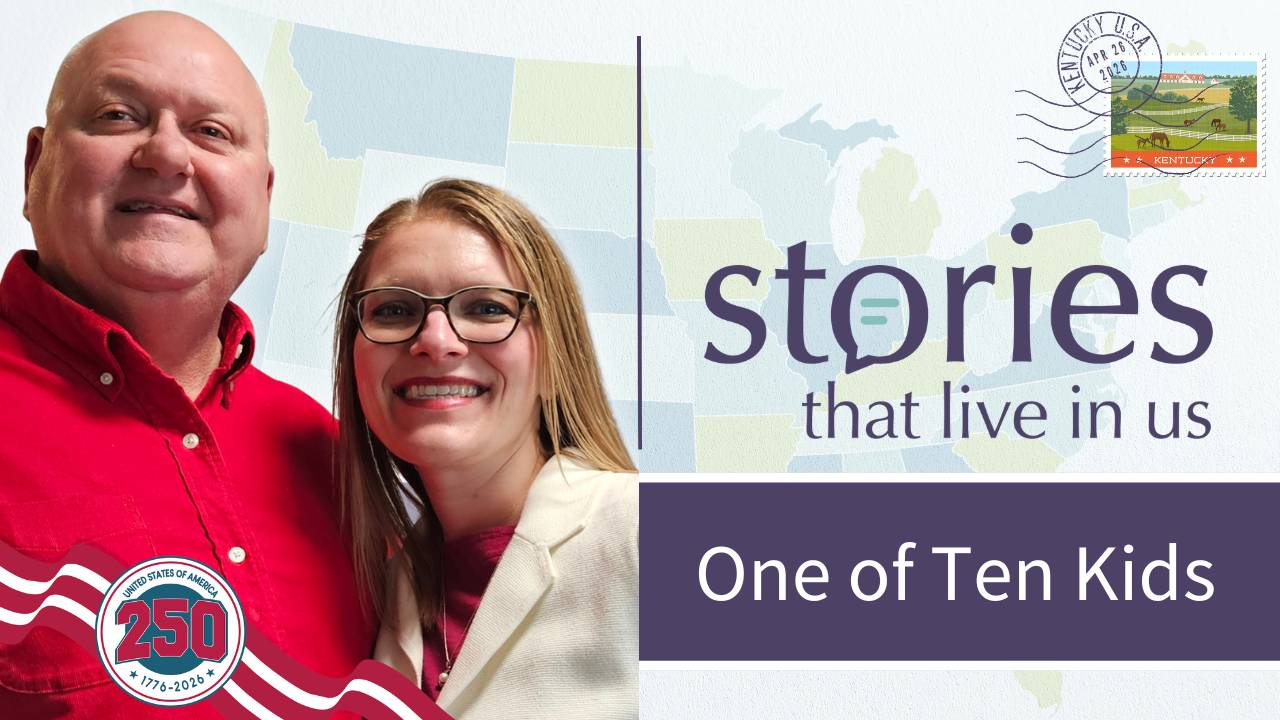
What if the most powerful proof of your family's legacy isn't hiding in a record database somewhere but sitting right on the wall of an old log cabin on a Kentucky creek?
I've spent decades helping people discover their family stories. And every once in a while, I sit across from someone whose family has done everything right — kept the land, preserved the quilts, hosted the reunions, cooked the turtle (yes, I said, “the turtle”) — and I just have to sit back and take notes.
That's exactly what happened when I invited my Ancestry colleague Caitlyn Bruns and her dad, Paul Abell, onto the couch for this week's episode of Stories That Live In Us.
Meet Paul and Caitlyn
Caitlyn is a genetic scientist turned marketing strategist here at Ancestry. She grew up in Bowling Green, Kentucky, about an hour from both sets of grandparents — which, as she'll tell you, is a genuinely rare and beautiful thing. She's an only child who somehow grew up with 32 first cousins on her dad's side alone. (The math works out when your dad is one of ten kids.)
Paul is the youngest of those ten (but not the baby, go figure). Born and raised in Adair County, Kentucky, he went to college a whopping 90 miles away. And when he found that way too far from home, he came back. He's been there ever since. And when Caitlyn was born in 1988, he finally had the reason he needed to do what his uncles had been nudging him toward for years: dig into the family tree.
He's been digging ever since. And what he's found — and what he's kept — is something most of us can only dream about.
The Cabin on Casey Creek
Here's where it gets really good.
There's a property in Adair County, Kentucky, right on Casey Creek, that has been in Paul's family since the post-Revolutionary era. We're talking land grants from the 1780s, Catholics who migrated south from Maryland, and ancestors who settled so deeply into that hollow that, as Paul put it, "pretty much everybody up in that area" is related to him in some way.
The main structure on the property? Three log cabins joined together in an L-shape. One was a general store. One was a post office. And the Abell family has served as postmasters in that community across multiple generations — from William Riley Sanders (Paul's great-great-grandfather) all the way down through Paul's grandfather, who carried the mail first by mule and then by Jeep, to Paul's own father, to Paul's brother, who retired from the postal service in Texas. Paul himself worked for UPS.
The post office practically runs in their blood. (Paul's words, not mine. But I couldn't have said it better.)
Paul acquired the cabin in 2010 when his father passed. He tore out the floors and put them back in. He hung old farm equipment and family photos. He has an aunt's rocking chair, sixty or seventy quilts (including a tumbling block pattern his great-grandmother pieced and his mother finished quilting) and a growing collection of Abell family heirlooms that an unmarried aunt thoughtfully preserved and eventually handed over to him, knowing he'd do something meaningful with them.
And he has.
But of all his siblings, why is Paul the one who ended up as the keeper of all of it?
"I Said Yes Before She Asked Anybody Else"
When I asked Paul why he was the one who ended up with the cabin and not one of his nine siblings, he got quiet for just a second. Then: "My mom asked me, and before she asked anybody else, I said yes."
I'll be honest, that resonated with me.
Because there's always one person in a family who says yes. One person who shows up, who hosts the hundred-person Christmas, who schedules four family gatherings a year, who knows that the cabin isn't just a piece of property — it's the place where the story lives.
Paul is that person. And because he said yes, his family still has somewhere to come home to.
From Maryland Catholics to Kentucky Creek Hollows
The Abells' roots in Kentucky run back to just after the Revolutionary War, when Catholic families from Maryland followed land grants south and west, settling first in Marion County (near Rolling Fort) before eventually making their way to Casey Creek in Adair County. Paul's mother was a Wethington — another Maryland Catholic family that came down in the same migration.
On Kathy's side (Paul's wife and Caitlyn's mom), the deep roots run through North Carolina and Virginia, with land grants of their own. And both sets of Caitlyn's grandparents ended up living about 20 minutes from each other — which meant that growing up, she was close to everyone.
What I love about this family's story is that Paul didn't need a dramatic mystery to get him interested in genealogy. He just needed a child. And then curiosity took over. He's still working on a Civil War puzzle. The family legend says two great-grandfathers fought on opposite sides, but the records keep suggesting otherwise. He hasn't solved it yet. (I don’t doubt that he will.)
The Whole Story
If you haven't listened to my conversation with Paul and Caitlyn yet, do yourself a favor and get comfortable.
Prefer audio? Click here to listen on your favorite podcast app.
🎧 Listen to the full episode to discover:
- How a Tina Knowles book tour is what got Caitlyn on this podcast (I promise it makes sense)
- The story of how Paul's parents met — on a double date, with the wrong people
- What a turtle cook actually involves (it's exactly what it sounds like, and also nothing like you'd expect)
- How Caitlyn experienced both sets of grandparents growing up, and why she says that's something most people just don't get
- Why Paul's answer to "did you ever think about leaving Kentucky?" is basically just a really polite version of "absolutely not"
The Power of One Story
There's a moment in this episode that I keep coming back to.
Paul is talking about growing up in a community where second and third cousins were just... friends. You went hunting with them. You double-dated with them. You didn't think of them as cousins; you thought of them as your people. And now, in retirement, he's the one making sure that web of connection doesn't unravel. He's scheduling four gatherings at the cabin in the coming year. He's the one who said yes.
That's what this episode kept coming back to for me. Not just the records (though there are great ones). Not just the lineage (though it's fascinating). But the choice to keep gathering. To keep the cabin. To keep cooking turtle (no judgment, genuinely) and inviting the cousins and making sure the next generation knows where they come from.
Family history isn't just about the names on the branches of the family tree. It's about the land, the heirlooms, and the connections to the people who choose to keep showing up. You don't have to have a 200-year-old log cabin to do this. You just have to be willing to say yes.
Your Story
As you listen to Paul and Caitlyn's story, I want you to think about your own family's gathering places. Maybe it's a grandparent's house you visit every holiday. Maybe it's a lake cabin or a front porch or a kitchen table. Maybe it was something like that, and it's gone now.
And then I want you to think about this: Who in your family is the Paul? The one who says yes, who keeps showing up, who holds the stories? Do they know how much that matters?
Maybe it's time to tell them.
Story Seeds 🌱
Plant these conversation starters and watch your family stories grow.
- For parents or grandparents: "Is there a place — a house, a piece of land, a neighborhood — that feels like the heart of our family? What do you remember most about being there?"
- For aunts, uncles, or older cousins: "Who in our family was the one who kept everyone together? What did they do that made you feel like you belonged?"
- For anyone who remembers the old gatherings: "What's the biggest family reunion or holiday celebration you can remember? Who was there, and what did you eat? (No detail too specific. I want it all.)"
- For your siblings or cousins: "Is there a family heirloom — a piece of furniture, a quilt, a tool, anything — that you've always wondered about? Who made it, and where did it go?"
Story Sparks 🔑
Unlock your family's hidden stories with these research techniques.
- Search military records for land grants. If your family has roots in the late 18th century United States, there's a real possibility they received a land grant in exchange for Revolutionary War service. On Ancestry, search the "U.S., Revolutionary War Pension and Bounty-Land Warrant Application Files, 1800-1900." These files often contain detailed personal and family information beyond just military service.
- Follow religious migration patterns. Paul's Catholic ancestors migrated from Maryland to Kentucky as part of a documented Catholic settlement movement. If you know your ancestors' faith tradition, search for histories of that denomination's expansion in your ancestral region. You may find entire community records that place your family in context.
- Search for postmaster records. If your ancestor served as a postmaster, there are actual appointment records. Search "U.S. Appointments of U.S. Postmasters, 1832-1971" on Ancestry. These records can confirm dates, locations, and occasionally the names of predecessors, helping you build out a timeline and connect to the community your family served.
- Use the Map feature with Ancestry Pro Tools to visualize migration. When you've added birth locations for multiple generations, click the "Map" view in your Ancestry family tree to see life events of your ancestors plotted geographically. For families like the Abells who stayed in one place for generations, this is remarkably satisfying. For families who moved frequently, it can reveal migration patterns you never noticed before.
Ready to hear more stories like Paul and Caitlyn's? Subscribe to Stories That Live In Us wherever you listen to podcasts. And if this episode moved you — if it made you think about your own gathering places and the people who kept them — please leave us a rating and review. It helps other family story seekers find their way here.
Stories That Live In Us drops every Thursday. I'll see you next week.
© 2026 Crista Cowan. All rights reserved.