North Carolina: Buried Treasure, Buried Stories
Apr 16, 2026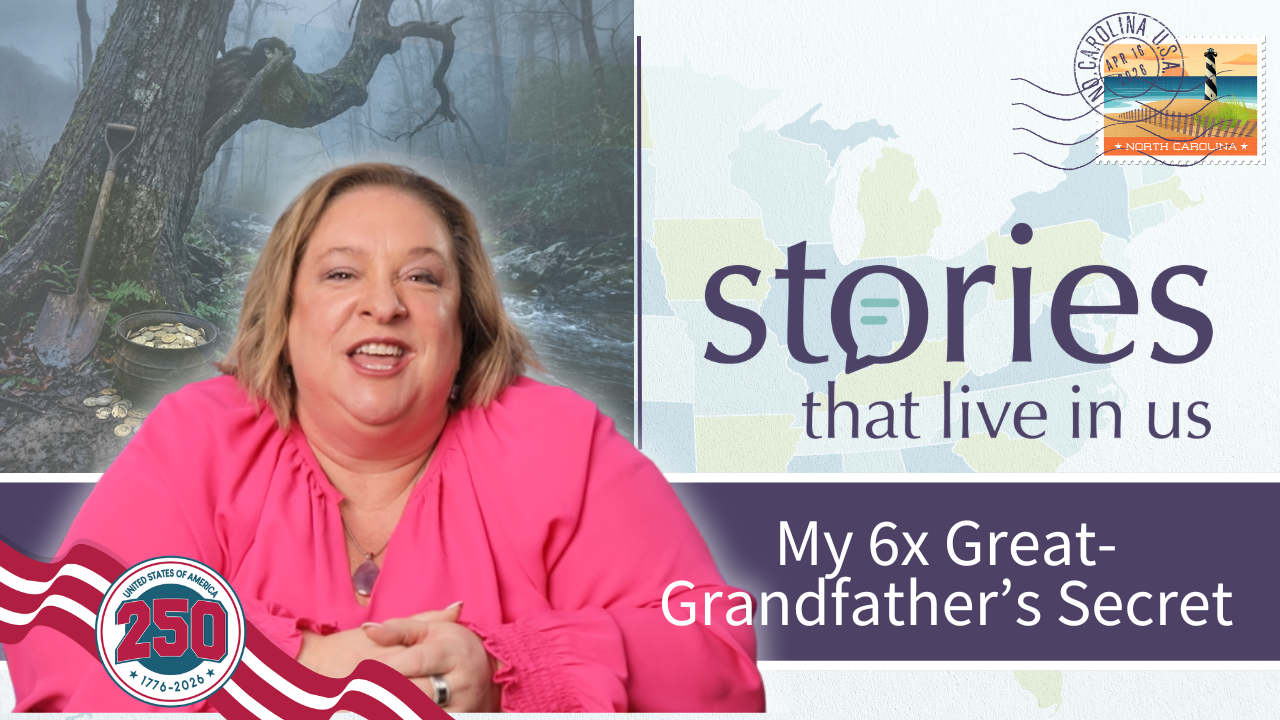
Have you ever found someone in your family tree who seemed like just a name and a date, only to discover they lived a life so extraordinary you can hardly believe you're related to them?
How My 6x Great-Grandfather Became a Ghost Story (And What He Can Teach Us About Our Own Families)
That's exactly what happened to me one Sunday night, elbow-deep in AncestryDNA matches with my dad on FaceTime (our favorite weekly ritual, you know). I was following a vague branch of my tree, one of those lines where the names don't have any context yet, when I found him.
Abraham Kuykendall. Born October 1719 in Orange County, New York. Died April 1, 1812 in Flat Rock, North Carolina.
My six times great-grandfather.
I started doing some math in my head and thinking a little about the historical context of his life. Then I googled him. This man lived 93 years. He was born before George Washington. He crossed colonial America, fought in the Revolution, raised 13 children across the frontier, and built an empire of 2,000 acres in the Blue Ridge Mountains from absolutely nothing. But history doesn't really remember any of that.
History remembers him as a ghost story.
"The most powerful man in the history of what is now Henderson County, North Carolina… is remembered primarily as a ghost story… He became a legend instead of a man with stories."
The Man Behind the Legend
Abraham Kuykendall was Dutch, baptized in the Dutch Reformed Church in Deer Park, New York, back when the American colonies were still very much British. He married Elizabeth Fidler in 1743, and together they moved across Virginia, into what is now West Virginia, down through the Carolinas, out to Tennessee, and back again. Thirteen children. More than 50 years of marriage. A life of constant motion and reinvention.
He was a corporal at 28, a captain by 51, and still serving on the Safety Committee as the American Revolution began. When Rutherford County, North Carolina was created in 1779, Abraham was one of the commissioners who chose where to put the courthouse. He was literally deciding, in real time, what this new country would look like on the ground.
By his 70s, when most men go looking for a rocking chair, Abraham was building a tavern, a grist mill, a sawmill, a distillery, and giving land for a church in the Blue Ridge Mountains. (The Mud Creek Baptist Church he helped establish in 1804 is still a functioning congregation today.)
But here's where the story takes a turn. Or rather, here’s where a recitation of the facts of a life lived 250 years ago becomes a story. Abraham had a policy at his tavern: gold or silver coins only. No paper, no credit. And over the years, he accumulated a significant fortune in coins that he kept under his own roof. Because on the frontier, there were no banks you could trust.
Then his wife Elizabeth died. At age 85, he remarried a widow named Bathsheba, about 20 years younger than him. And somewhere in there, Abraham, this man who had spent his entire life being the one who decided everything, controlled everything, trusted no one with anything important, got nervous.
So he did what he always did. He took matters into his own hands.
The Whole Story
If you haven't listened to the full episode yet, I promise it's worth it. There are layers here I couldn't fit into a blog post (including a part of the story that the ghost-story enthusiasts tend to skip right past, but I don't).
Prefer audio only? Click here to listen on your favorite podcast app.
🎧 Listen to the full episode to discover:
- The night Abraham blindfolded two enslaved men and led them through the woods with a heavy iron pot
- Why those two men, whose names history did not preserve, are actually the heroes of this story
- The working theory of how Abraham ended up face down in Pheasant Branch with a shovel beside him
- The ghost sightings that began within weeks of his death and haven't stopped
- Why treasure hunters (and one “archaeological dig”) are still searching Flat Rock more than 200 years later
- The single choice that turned an extraordinary man into a legend instead of a legacy
The Power of One Story
Abraham Kuykendall got exactly what he was afraid of. Not in the way he expected, but he got it. He didn't lose his fortune to a thief. He didn't lose it to Bathsheba's spending. He lost it to himself. He lost it to the same stubborn, fiercely independent quality that had made him extraordinary in the first place. The absolute, unshakable conviction that he was the only person who could be trusted with what mattered most.
"The things you protect by hiding them, you usually end up losing them."
The gold is still in the ground somewhere near a large bent white oak (unless someone absconded with it and somehow managed to keep that a secret). His grave is unmarked. The monument at Mud Creek Baptist Church Cemetery, placed there in 2000 by the DAR chapter named for him, is lovely but it's not where he's buried. Nobody knows where he's buried.
What I wanted to know, what I would have given anything to know, is what he actually thought about. What did it feel like to be a corporal at 28 during the Spanish Alarm? What did he and Elizabeth talk about on those long moves through the frontier? What did he hope for? What was he afraid of?
Those things, if he ever shared them, didn't survive.
And that is the actual tragedy of Abraham Kuykendall. Not the buried gold. The buried man.
Your Story
In my work, I hear the same sentence over and over, and it breaks my heart every single time:
"My mother died before I could ask her." "My grandmother's gone, and I never got her stories." "I didn't know I needed to ask until it was too late."
Abraham had 13 children, 2,000 acres, and a pot of gold. He kept the gold so safe that nobody could find it. (Not even him.) And eight generations later, here I am, his 6x great-granddaughter, piecing his life together from land deeds and militia lists because he didn't leave us the stories.
Your family has buried treasure, too. Not in iron pots under oak trees (though wouldn't that be fun?). It's buried in the unspoken stories. The memories that feel ordinary to the person who lived them and would feel extraordinary to the people who come after. The answers to questions your grandchildren haven't even thought to ask yet.
You haven't run out of time. Abraham did. You don't have to.
Story Seeds 🌱
Plant these conversation starters and watch your family stories grow.
- For parents or grandparents: "What's the boldest thing you've ever done? The kind of decision that completely changed the direction of your life, even if nobody else noticed at the time?"
- For aunts and uncles: "Who in our family was known for being stubborn, independent, or doing things their own way? What stories do you remember about them that I might not have heard?"
- For siblings or cousins: "What's something about our grandparents (or great-grandparents) that you remember that you've never told me? Even something small you think I already know?"
- For yourself: "If my great-great-great-grandchildren could ask me one question about my life, what would I want them to ask? And what would I want them to be able to answer?" (And then write your answer down!)
Story Sparks 🔑
Unlock your family's hidden stories with these research techniques.
- Look at the "vague" branches of your family tree. The lines where you have names and dates but no context are exactly where the most interesting stories are hiding. Pick one ancestor who feels like just a name to you, and spend an afternoon on Ancestry and FamilySearch. Dig for every record you can find and be sure to use full text search. Pay special attention to the records most of us skipped over when we were newbie genealogists—land deeds, militia lists, tax records, church records.
- Use Ancestry Pro Tools to filter the list of all people in your tree looking for any ancestors born before 1760 who were living in the United States. These people are the candidates in your tree for Revolutionary War service - military or patriotic, male or female. Their service may open up a whole new set of records for you to explore, including pension files and bounty land grants.
- Set up a custom MyTreeTag for "Frontier Ancestors" or "Migration Pioneers" and systematically tag every person in your tree who moved across state lines during the colonial or early American period. Patterns of migration often reveal family groups traveling together—which means DNA matches are likely hiding in those same migration paths.
- Start a Sunday night research ritual. Mine is FaceTime with my dad while my mom eavesdrops from the next room. Yours might be Zoom with your sister, or a weekly coffee date with your cousin, or you could join pajamas & pedigrees where we’ve just launched weekly “Jam Sessions.” Our community members (they call themselves “Jammers”) get together for two or three hours and work on their own family history, together. The magic isn't in the method—it's in the consistency. The best discoveries happen when you keep showing up.
Remember. Share what you know. Tell the stories that feel too small or too ordinary or too complicated. Write them down. Record them. Sit across from your mother or your grandmother or your aunt and ask the questions you've been meaning to ask. Don't wait until the family tree is finished to print it out and hang it on your wall as a conversation piece. Don't wait until the research is complete to share the stories.
Because the difference between a legacy and a ghost story is whether you share it or bury it.
Ready to discover more stories like Abraham's? Subscribe to Stories That Live In Us wherever you get your podcasts. And if this episode moved you, please leave us a rating and review—it helps other family story seekers find us.
Want to turn your family tree into a conversation piece that gets your stories out of the computer and into your living room? Visit Family Chartmasters to schedule a free consultation. Your family's stories deserve more than a spot in a digital file—they deserve a place of honor on your wall.
© 2026 Crista Cowan. All rights reserved.