Tennessee: A Patriot From the Holler
Mar 19, 2026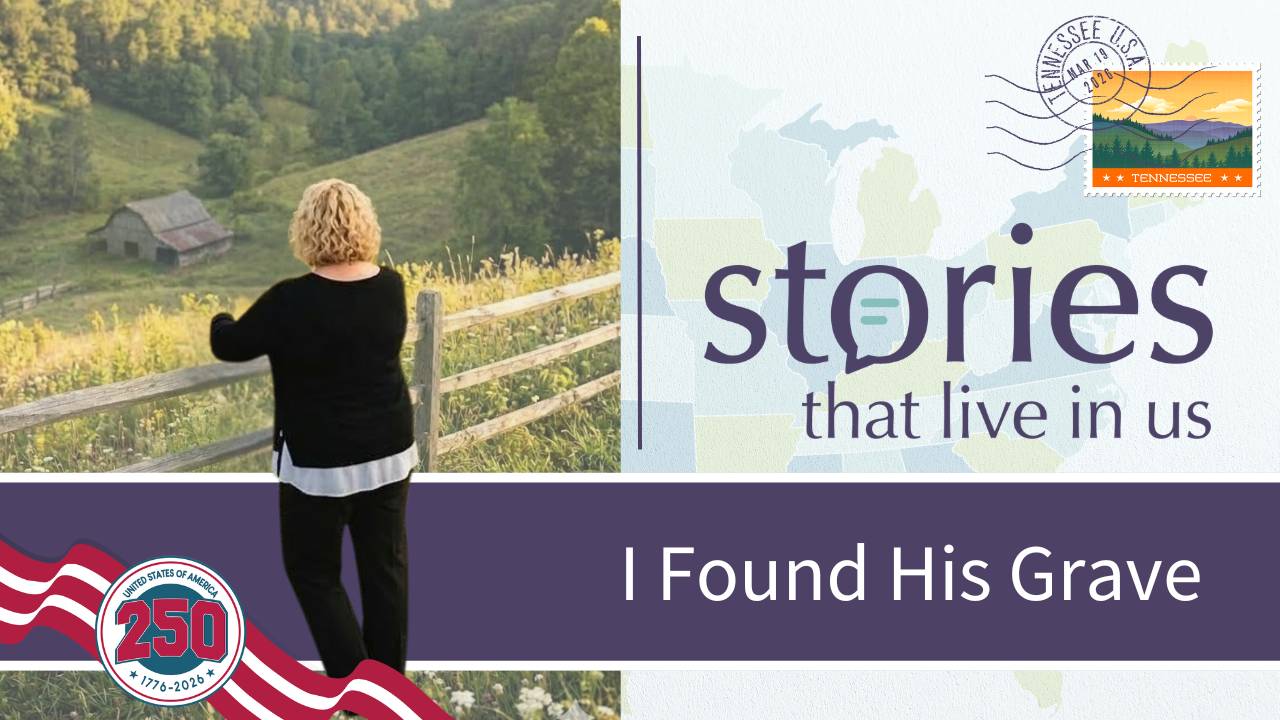
Have you ever stood at someone's front door, heart pounding, not entirely sure if you were about to be welcomed in or sent running? And then you realized that the person on the other side might hold the key to a story your family has been waiting generations to tell?
That's exactly where I found myself in May of 2012. On a rickety porch in a tiny little holler in Northeast Tennessee. My parents in the rental car behind me. (I'm fairly certain the doors were locked.) A very large dog on the other side of a very thin screen. And a woman who I wasn’t certain was going to offer me sweet tea or sic her dog on me.
She didn't invite me in for sweet tea. But she didn't sic the dog on me either. I call that a win.
The Pension File That Started Everything
I've been doing genealogy research my whole life. I mean that almost literally. My parents tell stories of parking me under a microfilm reader at the Family History Library while I was still in a baby carrier. So it takes a lot to make me catch my breath over a document.
But a Revolutionary War pension file? Those get me every time.
That's the story at the heart of this week's episode of Stories That Live In Us. It's a solo episode — just me, my ancestor, and a pension file that turned into a cross-country road trip to the most beautiful, isolated little corner of America I've ever stood in.
His name was Daniel Jones. Born in 1757 in Orange County, North Carolina. Right in the Piedmont, between the coast and the Appalachian Mountains, in a region increasingly full of Scots-Irish and German settlers who were, to put it politely, not exactly enthusiastic about British rule.
Daniel was twenty-two years old when he enlisted in the militia in December of 1779. And what he did over the next twelve months is the kind of story I want everyone to understand is hiding inside their own family trees right now.
A Soldier Who Kept Showing Up
Here's what gets me about Daniel Jones: he didn't just serve. He served, got discharged, turned right around, and enlisted again. Three times.
He marched from Hillsborough, North Carolina, all the way to Charleston in winter (a journey of three to four weeks on foot) to help fortify the city against a British siege. His enlistment ended on March 24, 1780. His company left Charleston. Five days later, the siege began. Six weeks after that, the city fell.
Back in Hillsborough, Daniel immediately re-enlisted.
His second tour took him to the Battle of Camden in August of 1780, one of the worst defeats of the entire Revolutionary War. General Gates had 4,000 soldiers. Cornwallis had 2,000. The Patriots lost nearly half their men. And General Gates? He fled 180 miles in just a few days. He was relieved of his command shortly after.
Daniel Jones? He re-enlisted. Again.
His third tour had him doing what I have to admit sounds almost cinematic: “to harass British and Loyalist supply lines and troops as Cornwallis moves north.” Terrifying in practice, I'm sure. But in the language of a pension file, it sounds almost like an adventure novel.
That's your ancestor. That's the kind of sentence hiding in a pension file right now that could light up your imagination and send you down a rabbit hole to uncover exactly what has been written about the events your ancestors participated in. Or maybe what movies have dramatized it.
The Whole Story
This episode goes deep into Daniel's story — his three tours of service, the chaos of North Carolina's borders with Virginia and the newly forming state of Tennessee, the way a stray boar registration in an 1789 tax book led me to confirm exactly when he arrived in Hawkins County, and the moment I stood in that field in Beech Creek holler and could almost see him walking over the hill.
Haven't watched it yet? Click here now:
Prefer audio only? Click here to listen on your favorite podcast app.
🎧 Listen to the full episode to discover:
- Why the colonists' deep distrust of a "standing army" meant Daniel was simultaneously a farmer, a father, and a soldier — often all in the same year
- The fascinating story of how Hawkins County, Tennessee, sits at the crossroads of three major migratory trails — and why that matters for your own family tree
- What a stray boar can tell you about when your ancestor settled somewhere (yes, really)
- How one pension file, written when Daniel was an old man living with his youngest son, painted a picture of an entire life
- What it felt like to stand on that porch, stare down that dog, and hear the words: "I reckon so."
The Power of One Story
I'll be honest with you. When I started researching Daniel Jones, I expected to find dates. Names. Maybe a census record or two. What I didn't expect was to feel like I knew him.
The thing about a pension file is that it forces your ancestor to tell his own story in his own words. He had to describe his service — who he served under, for how long, what he did — in order to receive that $30-a-year pension he'd earned.
Thirty dollars a year. For marching to Charleston in winter. For surviving Camden. For harassing Cornwallis's supply lines while his young wife waited back in that holler.
He collected three years of that pension before the records go quiet. He died in 1841 at the age of 84, having raised eight children in that little corner of Tennessee — six boys, two girls, all of whom lived to adulthood, almost all of whom stayed right there in Hawkins County and raised their own families.
Over 4,000 identified descendants now carry his story forward.
Your Story
Here's what I want you to sit with after you listen to this episode: the ancestors who feel the most gone — the ones who are just a name and two dates on a census — are often the ones with the most extraordinary stories hiding in plain sight.
Daniel Jones didn't make the history books. He wasn't a general or a founding father. He was a farmer with a militia musket, a wife back home, and an apparently unshakeable belief that if he got discharged on a Tuesday, he could probably re-enlist by Thursday.
Sound like anyone in your family?
The records that tell those stories are out there. Revolutionary War pension files. Tax records. Bounty land warrants. Muster rolls. And sometimes, if you're very lucky and a little brave, a woman in Tennessee will tell you “I reckon so” through a screen door while a large dog has opinions about your presence.
Story Seeds 🌱
Plant these conversation starters and watch your family stories grow.
- For parents or grandparents: "Did any of our ancestors serve in the military? What branch, what war — and do you know any stories about what that was actually like for them day-to-day?"
- For older relatives: "Did our family ever move around a lot — from state to state or region to region? What were they looking for? What were they running from?"
- For anyone: "What's the bravest thing you know of that someone in our family ever did? Not a big famous moment — just something that took real courage in the middle of an ordinary life."
Story Sparks 🔑
Unlock your family's hidden stories with these research techniques.
- Search Revolutionary War Pension Files on Fold3. These files are a goldmine. They often contain first-person accounts of service, physical descriptions, and witness testimonies from neighbors who knew your ancestor. Just a few weeks ago I got to announce at RootsTech that Fold3 has run handwriting recognition against the full set of 2.4 million images of Revolutionary War Pension Files on their site. You can now search these records, not just for the pensioner, but for anyone mentioned by name in anyone else’s pension file as well.
- Look for your ancestor in compiled military service records and muster rolls. Even if you've already found a pension file, cross-referencing with muster rolls can tell you exactly which battles your ancestor was present for and who they served alongside. Search for “Revolutionary War” in the Ancestry Card Catalog to see the full list of databases available for you to explore.
- Use tax records to pinpoint when your ancestor arrived somewhere. The first appearance of a name in a county tax list is often one of the best clues you'll find for when they settled there, especially in frontier regions where land records came later. Search your ancestor's county and state in tax record collections on Ancestry.
I like to think Daniel Jones was terrified, brave, and stubborn in equal measure. He marched when he didn't have to. He came back when he could have stayed home. He built a life in a beautiful, isolated holler and raised a family many of whom, two hundred and some-odd years later, are still living within a few miles of where he settled.
That's not just history. That's identity. That's who you're made of.
And your version of Daniel Jones is waiting for you in the records right now.
Ready to find more stories like his? Subscribe to Stories That Live In Us wherever you get your podcasts. And if this episode moved you even a little, please leave us a rating and review — it helps other family story seekers find us.
© 2026 Crista Cowan. All rights reserved.