Ohio: Family Roots, Foundational Soil
Mar 12, 2026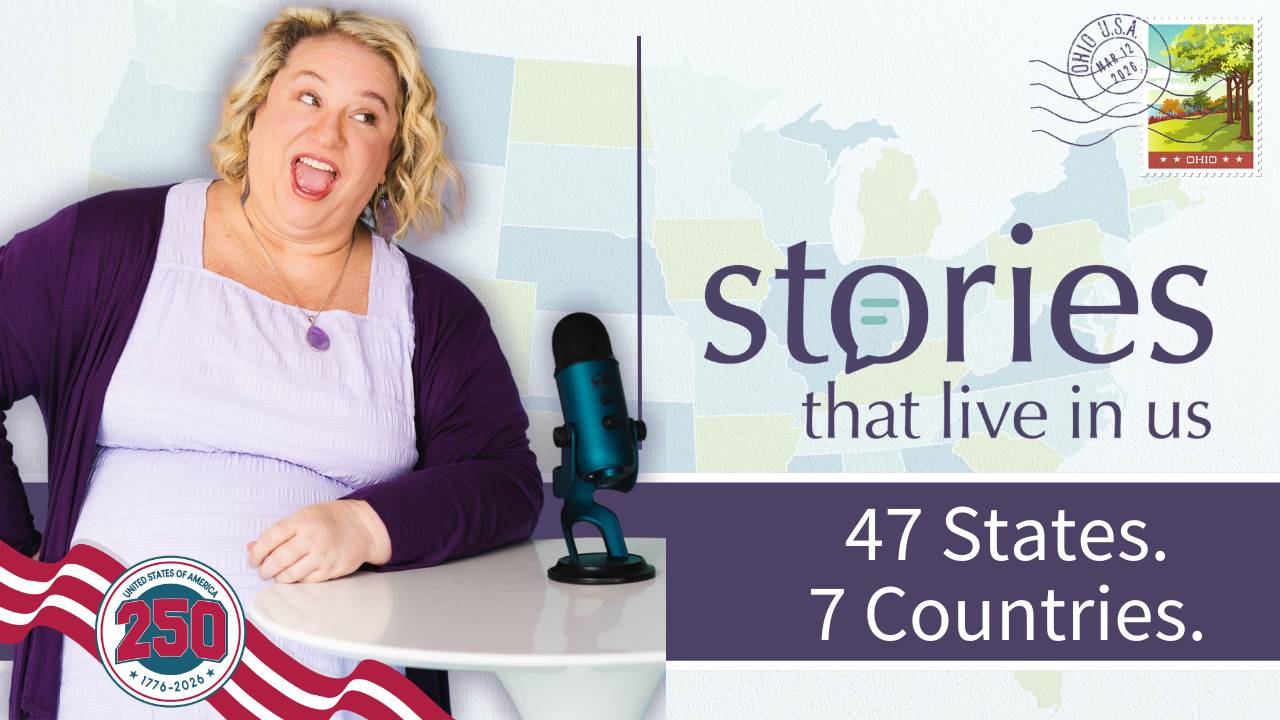
Have you ever stared at a name in your family tree and thought, where on earth did that come from? Not the surname. The middle name. The one that doesn't match anything else in the family. The one that makes you feel like you're missing something obvious, like walking into a room and forgetting why you came in.
I stared at two of those names for years. Jacob Pitzer Cowan. Robert Watson Cowan. Sons of my three-times-great-grandparents, George and Jane. And the answer, when I finally found it, was hiding in an 1830 census. Not in their record, but in the records of the neighbors living right next door.
But I'm getting ahead of myself. Because before we talk about census neighbors and name mysteries, we need to talk about a young Irish weaver who had to register as an alien citizen during the War of 1812. And what happened after that.
From County Down to a New Country
In this week's episode of Stories That Live In Us, I take you deep into the Cowan line of my family tree. It starts (at least as far back as I’ve been able to trace) with George Cowan. Born in County Down, Ireland, he immigrated to the United States sometime in his late 20s or early 30s. We don't know exactly when he arrived or who he came with. What we do know is that when the War of 1812 broke out, he had to register as an alien citizen, because his Irish origins technically connected him to the British and those were the very people we were fighting.
Think about that for a second. You've crossed an ocean, built a new life, and now the country you've chosen is at war with the country you came from, and you're caught somewhere in the middle. That's not just a genealogical data point. That's a story.
"The War of 1812 is really just kind of part two of the Revolutionary War..."
George eventually made his way to Pennsylvania, where he met and married Jane Conn, daughter of immigrants from the same county in Ireland. (Did they know each other's families before? I suspect maybe. The genealogist in me refuses to rule that out.) They settled in a little spot of land just west of Pittsburgh and raised their family in a region where state and county boundaries shifted so much over the decades that it looks like they lived in Pennsylvania, Ohio, Virginia, and West Virginia — when really, they never moved more than 20 miles.
And together, George and Jane did something that was genuinely remarkable for the time: they raised all thirteen of their children to adulthood.
The Whole Story
If you haven't already listened to this week's episode, do yourself a favor and press play:
Prefer audio? Click here to listen on your favorite podcast app.
🎧 Listen to the full episode to discover:
- How an 1830 census record finally explained two of George and Jane's children's middle names (and the neighbors who inspired them)
- The story of Robert Watson Cowan, saddle maker, Civil War contributor, and eventual postmaster general for his region of Ohio
- What I found the day I walked into a county historical society and didn't realize I was standing in a house built by my family
- The heartbreaking and complicated story of Dr. John Cowan, town physician and state legislator
- How Jacob Pitzer Cowan managed to serve in the U.S. House of Representatives while keeping his personal life almost entirely out of the newspapers (which, if you've ever read an 1800s newspaper, is basically a superpower)
The Power of One Story
Here's what gets me about this family.
George Cowan arrived in America as a young Irish immigrant — a weaver, a stranger, a man who had to legally register himself as a potential enemy during a war. And somewhere in those early years, he and Jane built something remarkable. Not just a family. A foundation.
Their children became doctors. Legislators. Business owners. Civil servants. Their grandchildren spread across Ohio, then Iowa, then Canada. And now (I've done the research) descendants of George and Jane Cowan can be found in 47 of the 50 states and seven countries around the world.
"I think that's pretty remarkable from a weaver in his late 20s who made his way from County Down, Ireland into Connecticut and eventually settled in Ohio and raised a family in a new country that was still trying to find its footing..."
That is not just one family's story. That is an American story. And it started with a man who had to prove he wasn't the enemy.
What I love most about this episode (and what I hope you take away from it) is that the clues to your family's story are sometimes hiding in plain sight. Not just in their records but also in the records of the people around them. The neighbor on the same census page. The doctor in the same small town. The name they gave a child that makes no sense until, twenty years into researching, you finally flip two pages back and there he is.
That's why we don't stop at the head of household. That's why we read the whole page.
Your Story
Think about names in your family tree that have always puzzled you. The ones that don't seem to match anything. Could they be honoring a neighbor, a doctor, a mentor, a friend? Someone who mattered enough to be written into a child's name for the rest of their life?
And think about your family's geography. Did your ancestors live in a region where state lines were redrawn around them? Is it possible they appear to have "moved" multiple times when really they stayed in the same house their whole lives?
Those geographic puzzles are some of the most satisfying to solve and some of the most commonly overlooked.
Story Seeds 🌱
Plant these conversation starters and watch your family stories grow.
- For parents or grandparents: "Do you know the story behind any of our family's unusual names? Were any of us named after people outside the immediate family — neighbors, doctors, friends?"
- For aunts or uncles: "What's the farthest back you can trace our family? Do you know what country or region they originally came from and what brought them to America? Did they come to the U.S. at a time when they might not have been welcomed?"
- For older relatives: "What do you know about how our ancestors actually lived day to day — were they struggling or were they comfortable? Are there any stories about how they provided for their family or what they sacrificed to keep everyone together?"
Story Sparks 🔑
Unlock your family's hidden stories with these research techniques.
- Read the whole census page, not just your ancestor's entry. When you find your ancestor in a census record, scroll up and down to see who their neighbors were. In the 1830 and 1840 censuses (which only list the head of household), the neighbors can tell you an enormous amount especially if you recognize any of the names from elsewhere in the tree. Also track who the neighbors were from one census to another. You may find families migrating together.
- Search for local and county history books on Ancestry. These books — many published between 1876 and 1976 — often include biographical sketches of prominent community members and founding families. If you’ve got the new full-text search feature on Ancestry, you may find a single mention of a family member that unlocks a whole new branch.
- Check mapofus.org for historical county boundary changes. The boundaries of the states and counties where your ancestors lived may have changed multiple times without them ever relocating. This site shows you exactly how those boundaries shifted, which can explain why the same family appears to have lived in three different states within a decade.
- When you find a middle name that doesn't match the family, treat it like a research clue. Search for that name as a surname in the same county and time period. You may find a neighbor, a doctor, a religious leader — someone significant enough to be honored with a namesake. It's one of the most quietly powerful research strategies I know. It reveals more of our ancestors’ stories.
George Cowan never became famous. He didn't serve in government or build a house that became a historical society. He was a weaver. He raised thirteen children. From the time he immigrated, got married, and “settled down,” he stayed in the same 20 mile radius, while the world redrew lines around him.
But Ohio was the soil he planted his family in. And what grew from that soil has now spread to 47 states and seven countries.
That's the thing about family history. You don't always know, when you're in the middle of living your story, what kind of foundation you're laying.
Ready to discover more stories like this one? Subscribe to Stories That Live In Us wherever you get your podcasts. And if this episode moved you, please take a moment to leave a rating and review — it helps other family story seekers find their way here.
© 2026 Crista Cowan. All rights reserved.